Hey everyone, Paul here from Stitch AI! 👋
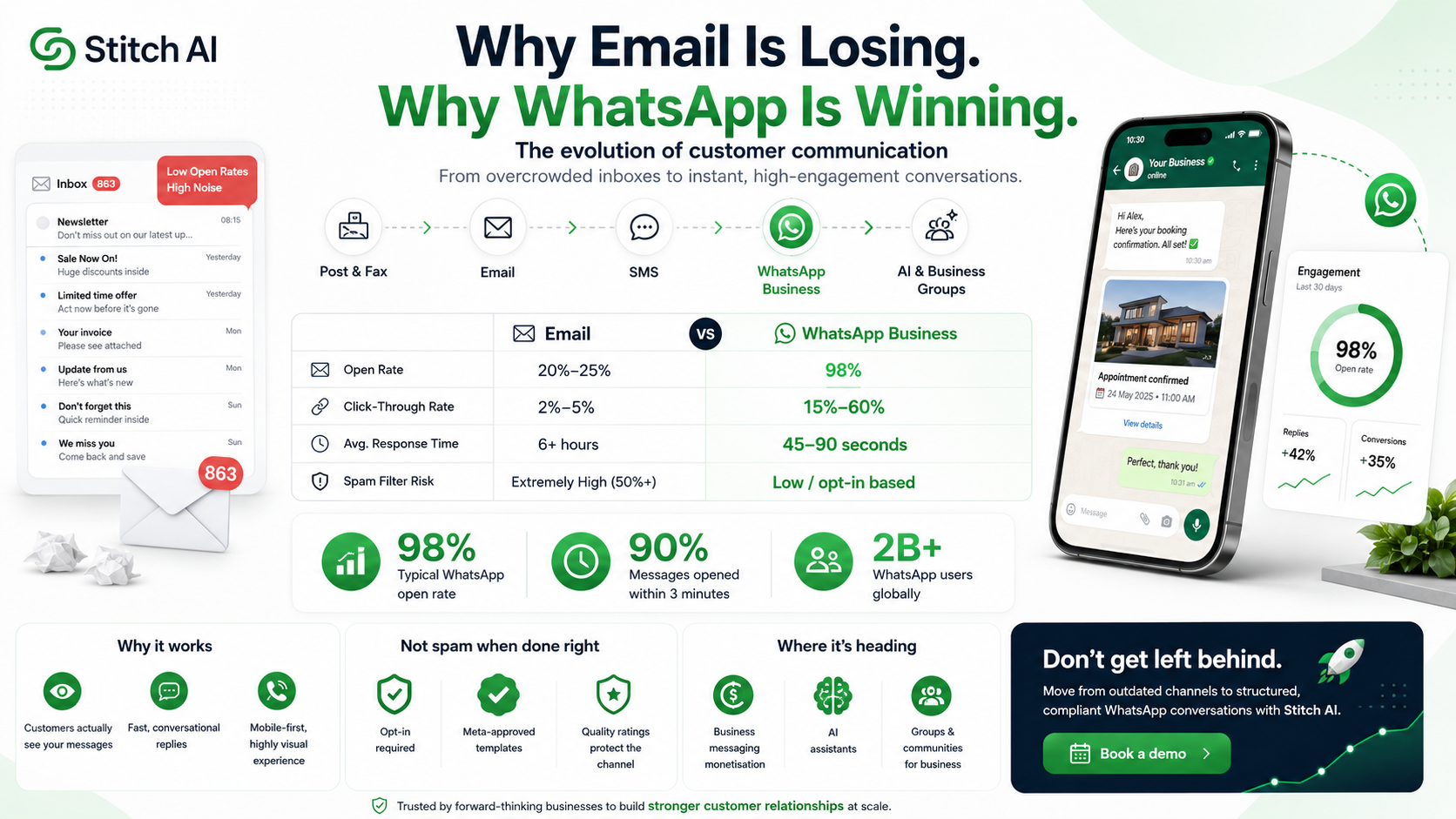
If you look back at how we used to run businesses twenty or thirty years ago, it’s wild to see how much has changed. We went from the slow, deliberate pace of traditional post and fax machines to the revolutionary dawn of email in the late '90s and early 2000s. Suddenly, you could reach a client halfway across the world in seconds. It was a golden age of business productivity.
But let's be real for a moment: that golden age is over. The channels that used to define cutting-edge customer communication are breaking under the weight of noise, spam, and changing human behavior. If your business is still relying heavily on standard email blast sequences or transactional SMS to drive customer action, you are playing a losing game.
Let's dive into the fascinating evolution of how we talk to customers, look at some hard statistics on why email is failing, address the "spammy" elephant in the room regarding WhatsApp, and pull back the curtain on Meta’s master plan for the future.
We've all seen it in our personal lives, yet many businesses refuse to accept it in their corporate strategies: people just don't open email like they used to. According to global email benchmark reports, the average open rate for marketing emails sits between a meager 20% and 25%. And even those numbers are often artificially inflated by tracking pixels and automated privacy systems (like Apple’s Mail Privacy Protection). If you look at click-through rates (CTR), the reality is even starker, averaging just 2% to 5% across most industries.
Where are the rest of your emails going? They are getting trapped in the digital graveyard. With strict new deliverability rules implemented by major providers like Google and Yahoo, more than 50% of promotional emails are automatically filtered out of the main inbox and routed into "Promotions" tabs or flat-out blocked by aggressive spam folders.
Even if your email does land in the inbox, it’s competing with hundreds of unread newsletters, invoices, and junk. The average response time for a business email is now 6+ hours. For a customer looking to buy a car, book a holiday, or rent a property, six hours is an eternity. By the time you reply, they’ve already moved on to a competitor.
Now, let’s look at the complete opposite end of the engagement spectrum.
Data from global communication platforms shows that WhatsApp Business messages achieve a jaw-dropping 98% open rate. But it gets better:
Why is it so effective? Because WhatsApp lands where your customers actually live. It sits directly between text threads from their family and chat groups with their best friends. It’s highly visual, completely mobile-first, and inherently conversational.
When I talk to business leaders, especially in traditional sectors like finance, trade counters, or recruitment, I often hear resistance: "Paul, WhatsApp is a personal app. Won't our customers find it invasive or spammy if we message them there?"
I completely understand that concern, but it stems from a fundamental misunderstanding of how the WhatsApp Business API actually works.
If you use a personal phone number to blast out unsolicited texts, yes, you will get blocked. But Meta has built the WhatsApp Business API with rigid, customer-first guardrails to ensure it never becomes a spam channel:
1. The Strict Opt-In Rule: You physically cannot message a customer via the API unless they have explicitly given you permission to do so. Your customers want to hear from you.
2. Approved Templates: Every single outbound promotional or transactional message must be approved by Meta before you send it. This completely eliminates low-quality, spammy broadcasting.
3. Quality Ratings: Meta monitors how users interact with your business. If people start blocking or reporting your number, your quality score drops, and Meta limits your messaging capabilities.
When done right through a platform like Stitch AI, WhatsApp isn't spammy, it’s an incredibly helpful, high-touch utility. Customers prefer it because they can get instant customer support, view real-time delivery tracking, sign documents, or confirm appointments with a single tap.
To understand where business communication is going, we have to look back at one of the biggest tech acquisitions in history. In 2014, Facebook (now Meta) bought WhatsApp for a staggering $19 billion.
At the time, tech pundits scratched their heads. WhatsApp was a completely free app with zero ads and no obvious revenue streams. Why pay billions for it?
Mark Zuckerberg knew that the company who controlled the future of mobile attention would control the global marketplace. WhatsApp gave Meta immediate dominance in massive, fast-growing emerging economies across Latin America, Asia, Europe, and Africa where traditional social media networks hadn't fully matured.
For years, Meta kept WhatsApp entirely free for users. But the long-term play was always B2C (Business-to-Consumer) conversation.
Instead of slapping ugly banner ads inside your private chats (which would ruin the user experience), Meta's brilliant monetisation strategy relies on paid business messaging via the WhatsApp Business API. Meta charges businesses a small fee per conversation tier (Utility, Authentication, Service, and Marketing conversations).
It is working spectacularly. By the end of last year, Meta’s WhatsApp paid business messaging segment crossed a massive $2 billion annual run-rate, making it one of the fastest-growing revenue engines in the entire company. Meta is making money by helping your business operate more efficiently.
Meta isn’t slowing down. Their ultimate vision is to turn WhatsApp into an all-in-one "Super App" for business, completely replacing legacy tools.
They are heavily rolling out advanced conversational AI tools, allowing companies to deploy intelligent agents that handle complex queries, book appointments, and collect customer data entirely within the chat window.
One of the most highly anticipated rollouts currently hitting the pipeline is the expansion of WhatsApp Groups and Communities functionality for the Business API.
Historically, the API was built for strictly 1-to-1 interactions. Soon, businesses will be able to manage compliant, structured, and automated group communication. Imagine a real estate agent managing a group chat between a home buyer, a seller, and a solicitor, or a trade counter managing a group with a contractor and their site team on the ground, all fully tracked, integrated with your CRM, and automated via Stitch AI.
The landscape of customer communication has permanently shifted. The businesses that continue to shout into the void of overcrowded email inboxes will see their conversion rates steadily dwindle. The businesses that move their core communications to a structured, compliant WhatsApp API framework will capture their market's attention.
At Stitch AI, we help modern enterprises transition smoothly away from outdated channels and onto the WhatsApp Business API without disrupting their teams.
Want to learn how your industry can leverage these tools? Want to hear the latest inside track on how Meta is rolling out groups, interactive flows, and AI features?
👉 Get in touch with the team at Stitch AI today to book a demo!