The speed at which a business replies to a WhatsApp enquiry has a direct, measurable effect on whether that lead converts or disappears to a competitor. Below, Stitch, the WhatsApp business communication platform, answers the most common questions UK businesses ask about response speed, lead loss, and how to fix slow reply times without adding headcount.
Before looking at specific benchmarks, it helps to understand why speed matters more on WhatsApp than on email or phone, and what actually happens to a lead the longer it waits.
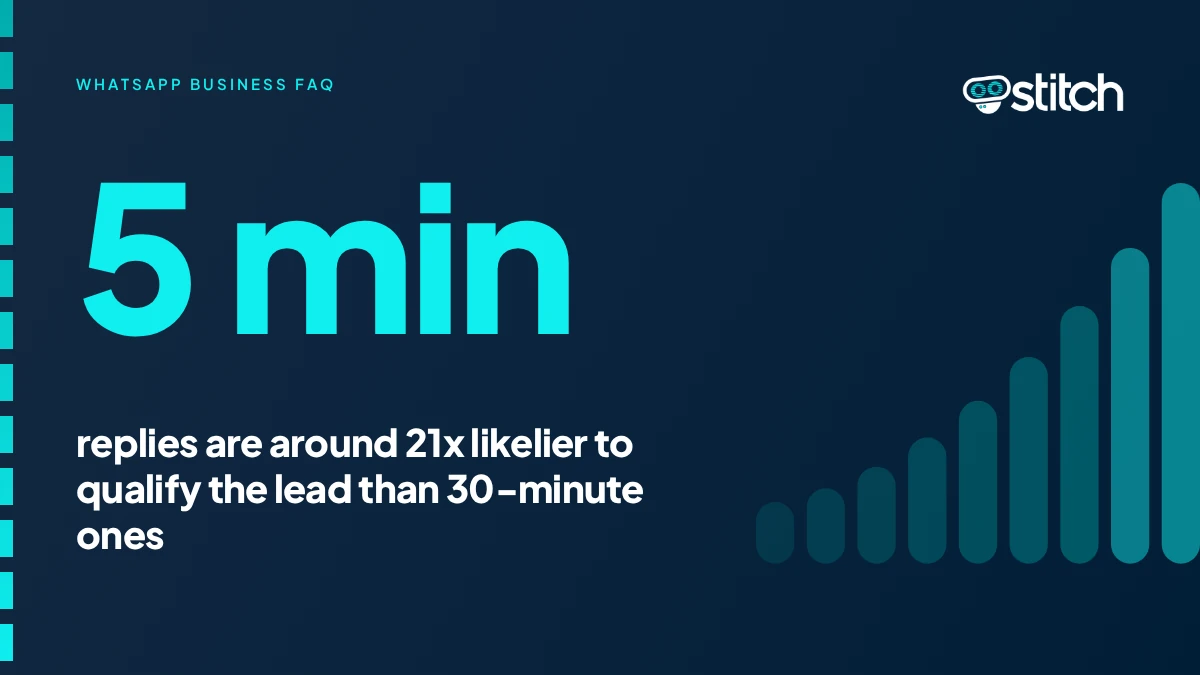
Five minutes is the benchmark that separates a warm lead from a cold one. Replying within 5 minutes rather than 30 makes a business around 21 times likelier to qualify the lead, and 78% of deals go to the first business to respond, even though the average business takes over 40 hours to reply to a new lead. That gap between a 5-minute reply and a 40-hour average is where most leads are lost, not to a better competitor, but to whichever business simply answered first. If your current process depends on a person checking a phone between other tasks, you are very unlikely to hit that window consistently.
WhatsApp compresses the expected response window because of how the channel is used and how visible a reply becomes. 90% of UK adults are on WhatsApp and open messages at around 98%, compared with marketing email that rarely clears a 20% open rate and outbound calls that now go largely unanswered. Because the customer sees a message land almost immediately, silence on your end reads as inattention rather than as a normal delay, the way an unanswered email might. This is also why 90% of people are expected to respond to WhatsApp enquiries within a short time frame themselves, since the channel sets an expectation of near real-time exchange in both directions.
The lead re-engages with whichever business responds first, often within minutes. Rightmove, Zoopla, Auto Trader, Motors and web-form enquiries are typically sent to multiple businesses at once, so a slow reply means you are racing other agents or dealers who may already have engaged the customer while you were still checking a queue the next morning. Portal and form leads that trigger an instant WhatsApp message keep you in that race while the lead is still warm, rather than starting the conversation cold hours or days later. Once a customer has moved on to a competitor's conversation, there is rarely a second chance to reopen that same enquiry on equal terms.
Yes, and this distinction matters most outside normal working hours. The goal out of hours is not an instant answer, it is instant engagement: a customer enquiring at 9pm does not need their question fully resolved immediately, they need confirmation that their message has landed and a clear idea of when a human will follow up. This works the same way as waiting for a taxi: standing on the kerb with no information makes every minute feel long, but the moment you know your car is twelve minutes away, the wait feels completely different even though the actual time hasn't changed. Applied to a Rightmove or Auto Trader enquiry at 8pm, a WhatsApp reply within seconds, a few qualifying questions, and a message confirming the sales team will follow up by 10am turns a dead end into a held lead.
Understanding the cost of a slow reply is one thing; building a process that consistently avoids it is another, and this is where most businesses hit the limits of manual, phone-based WhatsApp.
No single branch or team can maintain a 5-minute response window manually across evenings, weekends and busy periods. On the free WhatsApp Business app, the customer cannot make the first move at all outside of an existing conversation, so a buyer messaging at 9pm or a landlord with a weekend maintenance issue simply hits a dead end until someone next checks the phone. This is also true during the working day: without automation, responses are handled manually, which leads to potential delays and inefficiencies, particularly for agencies or dealers managing a high volume of enquiries across the same shared number.
An automated first response greets the customer immediately, asks qualifying questions, and hands the conversation to the right person with full context. On the official platform, a bot or AI assistant can greet the customer around the clock, ask qualifying questions, capture the relevant detail, and assign the conversation to the correct team for a human to pick up the next working day. When the negotiator or sales executive picks up in the morning, they continue the same conversation the customer already started, in one place, from the first automated greeting through to the human follow-up, rather than starting from scratch. Customers submitting a form or portal enquiry can receive a WhatsApp message within 30 seconds of that enquiry landing, which is the kind of speed that manual monitoring cannot match.
Between 70% and 90% of leads can be handled via WhatsApp messaging once a business moves off manual, one-at-a-time replies. Customers respond quickly once engaged this way too: 80% of customers respond within 5 to 10 minutes to WhatsApp automated messages, and separately, the expected response rate for WhatsApp enquiries is approximately 75% within four to five minutes. Handling that volume through WhatsApp rather than phone or email also reduces the load on traditional email systems, since 70-75% of enquiries can be shifted onto WhatsApp instead.
The free version of WhatsApp Business lacks the integration, automation, collaboration and compliance features needed to manage volume reliably. These gaps hinder effective communication management, especially for agencies or dealers handling numerous enquiries at once, where the absence of automation tools means responses are made manually and are therefore prone to delay. It also restricts who can start a conversation: because the customer cannot message first outside an existing chat window on the free app, any enquiry arriving outside business hours has no route to an instant, automated acknowledgement.
No, automated capture points such as a website chat widget can be added to route enquiries into the same WhatsApp inbox a team already uses. A chat widget positioned on the website, for example at the bottom right for visibility, lets customers start a conversation immediately rather than filling in a form and waiting for a reply. Mapping out the customer journey first, from the moment someone lands on a website or portal listing through to the message reaching the right person, is what ensures that speed advantage is not lost at the handover stage. This setup can also extend across more than one branch or site, with an additional branch typically costing around £25 per month on top of the base inbox.
Yes, integrating messaging with existing CRM systems is what allows a fast first reply to also be a tracked, accountable one. Connecting WhatsApp to a CRM streamlines communication and ensures customer enquiries are tracked and managed effectively rather than sitting in an inbox with no record of follow-up. Without that integration, a business can still reply quickly to the first message but loses visibility on whether the lead was actually progressed, which matters just as much as the initial speed once volume increases.
The speed of a response and the compliance of that response are separate questions, both of which need attention. Businesses must obtain explicit consent before messaging customers on WhatsApp, in line with Meta's policies designed to prevent spam and protect account health. Sending large volumes of messages at once, rather than a more gradual approach, risks excessive reporting or blocking by users, which can lead to account restrictions or bans regardless of how fast the underlying responses are. Businesses using personal WhatsApp accounts for this kind of volume also carry GDPR implications that a properly set up business platform is designed to address through exportable, trackable conversations.
High enquiry volume without automation creates the conditions for client churn as well as lost leads. Around 10% of client churn for lettings agencies comes mainly from overwhelmed, high-volume operations struggling to keep pace with inbound messages. On top of missed conversions, quick replies are what customers expect by default, and if they don't receive them, they often turn to competitors rather than waiting.
Start by automating the enquiry sources generating the highest volume, typically portal leads and web forms, since these can trigger an instant WhatsApp message the moment they arrive. For estate agents, learning how to respond to Rightmove leads faster using WhatsApp automation is often the most effective first step. From there, map the customer journey so the automated first reply hands off cleanly to a human with full context, rather than creating a second, disconnected touchpoint. Car dealers should also consider whether WhatsApp can handle Auto Trader leads and integrate with their existing DMS to ensure no enquiry is missed. Pricing for this kind of setup starts at £99 per month for an entry-level package, with automation features and AI bots adding between £150 and £600 per month depending on requirements. Businesses evaluating this shift should treat the 5-minute, 21-times-likelier qualification benchmark as the target to design around, since that is the number separating a captured lead from one lost to a faster competitor.
Welcome to this explainer. Look, if you are a UK business owner, an estate agent, a car dealer, or an operations lead handling high volumes of inbound enquiries, you absolutely know the daily struggle of keeping up.
Today, we're jumping straight into exactly why reply speed on WhatsApp dictates whether a lead actually converts and how Stitch AI's msgboxx solves this massive operational bottleneck.
We've got a lot of ground to cover, so here's our roadmap. We'll look at the five-minute conversion benchmark, the pressure of portal leads, the limits of manual replies, what automated first responses look like in practice, accountability and platform compliance, and finally, how to close that response time gap.
All right, let's jump straight into part one: the five-minute conversion benchmark.
Five minutes. That is the exact critical benchmark separating a warm lead from a completely cold one. Literally, the second an enquiry lands, the clock starts ticking, and the drop-off in engagement after this brief window is just incredibly steep.
To put this into perspective, when you hit this five-minute window, instead of waiting just thirty minutes, your team is twenty-one times likelier to successfully qualify the lead. Twenty-one times. Waiting even half an hour fundamentally degrades the quality of the opportunity sitting right in front of you.
And here is where the competitive stakes get very real. Seventy-eight percent of all deals go directly to the very first business that responds. Think about that for a second. You are rarely losing leads to a fundamentally better competitor. You're mostly losing to whichever business simply managed to answer first.
Yet, here is the shocking reality we have to address. The average business takes over forty hours to reply to a new lead. Over forty hours. By relying on slow manual processes, businesses are completely missing that five-minute window, effectively handing seventy-eight percent of their potential deals straight to fast arrivals.
So that brings us to part two: the intense pressure of portal leads.
Why does this specific channel create so much pressure? Well, WhatsApp fundamentally compresses the expected response window compared with email or phone. Marketing emails rarely clear a twenty percent open rate, and outbound calls are often unanswered, meaning customers just accept a certain level of delay. But WhatsApp boasts a massive ninety-eight percent open rate. Because a delivered message implies immediate visibility, silence on your end just reads as inattention.
And this pressure multiplies exponentially when portal leads go to several businesses at once. When enquiries trigger from platforms like Rightmove, Zoopla, or Autotrader, that exact same lead hits multiple agencies or dealerships simultaneously. You are instantly in a race. A slow reply guarantees you are losing that race while the customer engages with whoever got there first.
But here's a really interesting distinction for out-of-hours enquiries. You need to understand the difference between an instant answer and instant engagement. It's much like standing on a curb waiting for a taxi. A customer enquiring at nine PM doesn't necessarily need their issue fully resolved immediately. They just need confirmation that their message landed and a clear timeline for a human to follow up. Once they know someone will reply by ten AM, that frustrating feeling of waiting vanishes.
The limits of manual replies.
The hard truth here is that a team simply cannot hit five minutes by hand around the clock using the free WhatsApp Business app. The free app restricts your ability to make the first move out of hours, creating absolute dead ends for evening enquiries. Plus, managing high volumes on a shared number causes severe bottlenecks. If your overwhelmed staff are relying on checking a phone between tasks, hitting that benchmark is operationally impossible.
Okay, let's look at part four: automated first responses in practice.
This is where the workflow completely transforms. With Stitch AI's msgboxx, an automated bot instantly greets a portal or website chat widget enquiry, day or night. It then asks the necessary qualifying questions to capture key details. Finally, it seamlessly hands the complete conversation over to a human. So when your negotiator picks it up the next morning, they aren't starting from scratch. They have the full context.
The operational relief this provides is huge. By moving away from manual one-at-a-time replies, businesses can successfully handle between seventy and ninety percent of their initial leads via these automated WhatsApp workflows. Customers respond quickly to this, shifting the burden entirely off slower traditional systems.
Let's move to part five: accountability and platform compliance.
It's vital to separate these two concepts. First, you have accountability. Integrating msgboxx with your CRM or dealer management system ensures replies are actually tracked, preventing leads from sitting unrecorded on a single phone.
Then you have the separate compliance question. Meta requires explicit user consent, and you need careful volume management to maintain account health and avoid blocks. Using a proper business platform correctly addresses these specific needs. And finally, part six: closing the response time gap.
We have to remember what slow replies cost beyond just one lost lead.
Overwhelmed manual systems can actually cause up to ten percent client churn in lettings, for example.
To close the gap, your very first step must be automating the highest volume sources, like portal leads and web forms, to trigger instant msgboxx responses. Step two is mapping the customer journey for a clean human handover. And step three is integrating this messaging directly with your existing DMS or CRM.
You have to treat that five-minute, twenty-one times likelier qualification benchmark as the ultimate target to design your operations around. So what are you waiting for? Book a demo and see how faster WhatsApp replies would work for your team.